Thanksgiving 2025: Healthy Strategies for the Holiday
Thanksgiving 2025: Healthy Strategies for the Holiday
Every year around this time, someone asks me for Thanksgiving or overall holiday eating tips. It never fails. Even though it feels cliché to write about healthy holiday eating, people still want guidance, reassurance, and a little real talk. So yes, I am writing about it again.
I have said many things over the years about holiday eating. For example, the holidays are technically four days on the calendar: Thanksgiving, Christmas Eve, Christmas, and New Year’s Eve. In real life, the season lasts much longer because most of us have social lives: work parties, gatherings with friends, baking days, holiday potlucks. You get the idea. The holidays show up in so many ways for several weeks.
I have also talked about the average holiday weight gain. There has been a long-standing belief that people gain anywhere from 5 to 10 pounds between Thanksgiving and New Year’s, or even between Halloween and New Year’s. The truth is that most people do not gain that much. Many gain maybe 1 to 3 pounds, if that. The bigger issue is that some people do not lose that pound or three over the next year. That slow yearly addition can add up over time.
I have even organized Maintain Don’t Gain challenges where people weighed in voluntarily before Thanksgiving and again in early January. We also measured body fat percentage to discourage extreme crash dieting before the second measurement. Most participants did not gain weight. A lot of people lost weight – not a lot, but some. Some were honest with me about doing things to drop weight quickly before the follow-up. Others were mindful throughout the season. There was a mix. But it proved that holiday weight gain is not inevitable.
Years ago, I was interviewed on a local news segment that aimed to show how far you would have to walk to burn off the calories in a Thanksgiving meal. They reran it for years. I hated that message. The idea that you must earn your food or punish yourself for enjoying a holiday meal is neither helpful nor healthy. That mentality chips away at your relationship with food.
I could repeat all of these things because they are still true in many ways. You might even hear them from other professionals. But today I want to shift the focus. Instead of talking about weight, numbers, or walking off your meal, I want to talk about something more meaningful.
Here are ten Healthy Strategies for the Thanksgiving Holiday and beyond. These are grounded in mindfulness, satisfaction, hunger cues, connection, and true enjoyment of the day.
1. Start the day with a normal breakfast
Skipping meals to “save” calories usually backfires. Trust me, I’ve seen it many times, and year-round. A steady start helps your blood sugar and your appetite.
2. Notice your hunger before you eat
Go into the meal hungry but not ravenous. Check in with yourself before the first bite.
3. Pick foods you actually enjoy
Eat the items you look forward to all year and skip the ones you feel obligated to take. You do not need to eat something just because it is on the table.
4. Slow down your pace
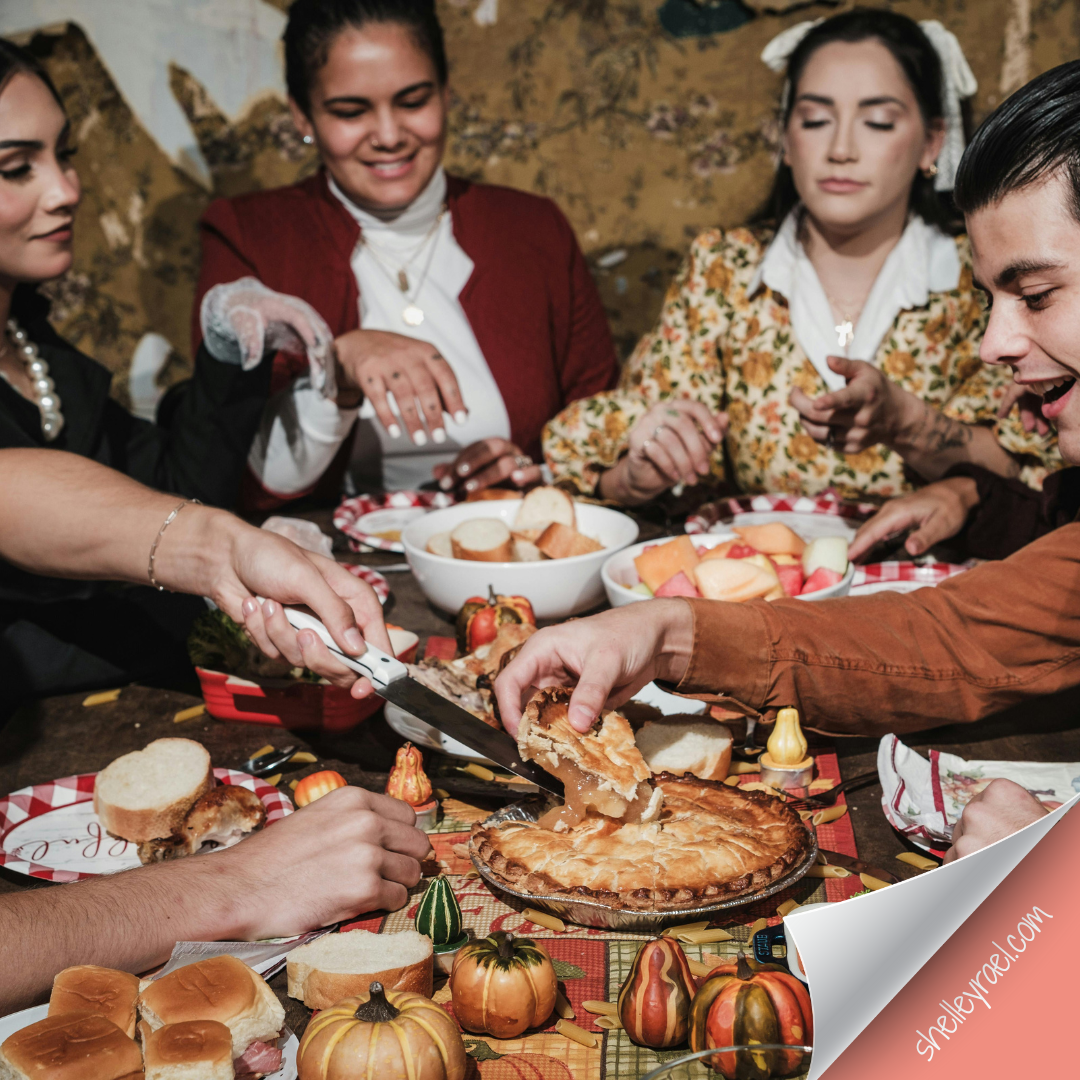
You do not need to eat in sync with the fastest eater at the table. Put the fork down between bites. Give your body a chance to register fullness – that’s usually 20 minutes!
5. Tune into fullness without judgment
Stopping when comfortably full is much easier when you give yourself permission to enjoy the food in front of you.
6. Take breaks during the meal
Talk, laugh, pause. This is a holiday, not a race.
7. Do not label foods as good or bad
Thanksgiving meals are meant to be enjoyed. Removing judgment can lower the pressure around eating. So, stop with the “I shouldn’t…”
8. Set realistic expectations for movement
If you want to take a walk, great. If you do not, that is fine too. Movement is not a punishment.
9. Focus on the people, not just the food
Sometimes the company is great. Sometimes you are simply putting up with it. But connection matters either way.
10. Let go of guilt
Food guilt has no place here. One meal does not determine your health. What you do most of the year matters far more than what you do on Thanksgiving Day or any of the other holidays over the next month.
Bonus Tip: Mind Your Own Plate
Thanksgiving tends to bring out the amateur food police. Some people comment on how much you take, how little you take, or what you choose to skip. The easiest rule is simple. Focus on your own plate and let others do the same. There is no need to comment on what someone else is eating or not eating. If someone comments on your choices, you do not owe a detailed explanation. A short and direct response is enough.
Here are some quick responses you can use if someone gets pushy.
When someone keeps offering food you do not want:
No, thank you. I am good right now.
I’m comfortable with what I have.
It looks great, but I am full.
When someone insists you should eat more because they cooked it:
I appreciate it. I am stopping here so I can feel good later.
Thanks for making it. I enjoyed what I had.
When someone comments on your portion size:
This is the amount that works for me today.
I chose what I wanted. I’m good.
When someone says you need to loosen up or just enjoy the holiday:
I am enjoying it. This is what feels right for me.
I promise I am having a good time. This works for me.
When someone implies you are not eating enough or eating too much:
I listen to my body. This is what it’s telling me today.
I am fine with my choices. No need to worry about me.
When someone will not let it go:
I am changing the subject.
Let’s talk about something else.
I am not discussing food choices today.
Remember that Thanksgiving is about enjoyment, gratitude, and connection. Your choices do not need judgment. They need to be realistic and aligned with what helps you feel your best. You can enjoy the holiday without turning it into a project or a test of discipline. Give yourself room to appreciate the day for what it is.