
The Glycemic Index: Helpful Nutrition Tool or Just Another Number?
If you have ever looked up the glycemic index of a food, you may have wondered what the number means. Is a low-glycemic-index food healthier? Should you choose foods with a lower number? And what about glycemic load? Is that something different?
Both terms describe how carbohydrate-containing foods affect blood glucose. They can be useful concepts, but they are also easy to misinterpret. Neither one tells you whether a food is healthy or unhealthy, and neither tells the whole story about how your body responds to a meal.
So what do each of these measurements mean, and how useful are they really in everyday eating?
First, a little explainer about blood glucose response after eating
Blood glucose, or blood sugar, naturally increases after you eat foods containing carbohydrates. This is a normal part of digestion and metabolism in everyone.
As we digest carbohydrates, glucose enters the bloodstream. Again, a normal part of digestion and nothing to freak out about.
The pancreas responds as it should by releasing insulin, a hormone that helps move glucose from the bloodstream into cells, where it can be used for energy or stored for later use. All good so far.
In a person with normal glucose regulation, blood glucose typically rises after a meal, peaks within about 30 to 60 minutes, and gradually returns toward premeal levels over the next two to three hours. The timing and size of that response vary by meal, person, and many other factors.
A rise in blood glucose after eating is not automatically a problem. It is an expected and normal physiological response. We can’t, and at least shouldn't, aim to prevent blood glucose from rising at all. The body is designed to manage these changes.
What is the glycemic index?
The glycemic index (GI) ranks carbohydrate-containing foods by how much they raise blood glucose compared with a reference food, usually pure glucose.
Researchers at the University of Toronto, led by Dr. David Jenkins, introduced the concept in 1981. At the time, researchers were looking for a better way to compare carbohydrate-containing foods and their effects on blood glucose, particularly for people with diabetes.
The GI is determined by giving participants a portion of a test food containing 50 grams of available carbohydrate. Researchers measure blood glucose over the next two hours and compare the response with the response to 50 grams of glucose.
The resulting number is expressed on a scale where glucose has a value of 100.
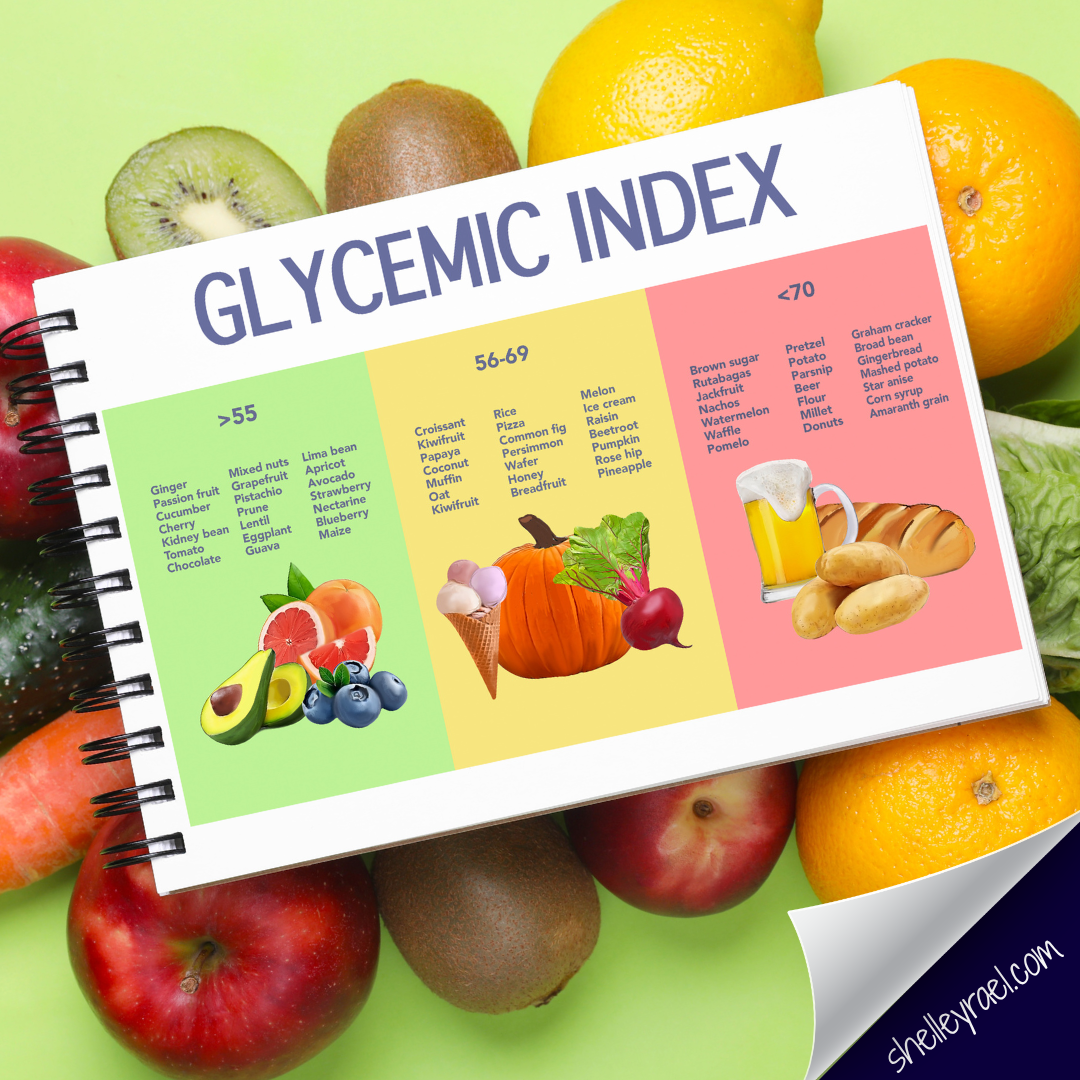
GI values are generally grouped into three categories:
Low GI: 55 or less
Medium GI: 56 to 69
High GI: 70 or higher
Some examples of reported approximate GI values include:
Apple: 36 – 40
Lentils: 29 – 32
Chickpeas: 28
Rolled oats: 55
Banana: 47 – 51
White bread: 70-75
White rice: 73 – 89
Watermelon: 72 – 76
These are examples, not fixed values for every version of a food.
Different varieties, preparation methods, and testing conditions can produce different results.
What does a GI number mean in everyday eating?
This is where the glycemic index can get misleading, and people often misinterpret it.
Remember, the test is based on eating 50 grams of available carbohydrate from one food. That doesn't necessarily reflect the amount most people eat at one time.
For some foods, 50 grams of carbohydrate is a reasonable serving. For others, it would be much more than someone would typically eat.
Let’s get some perspective.
Here is what approximately 50 grams of carbohydrate could look like:
A little more than one cup of cooked pasta
About one cup of cooked white rice
About two medium bananas
Around two to three medium apples, depending on size
About 4 - 5 cups of watermelon
Around seven cups of baby carrots
Roughly 1¾ to 2 cups cooked oatmeal
These are estimates, and actual amounts vary with the food and preparation method. The point is that the GI test does not necessarily represent a typical serving.
It also tests foods individually, in isolation or without any other foods.
Most of us do not sit down and eat 50 grams of carbohydrate from one food in isolation.
We eat meals that combine carbohydrates with protein, fat, and fiber. Those other components affect digestion and the resulting blood glucose response.
So, while the GI can help compare the blood glucose response to similar amounts of carbohydrate from different foods, it is not necessarily a practical day-to-day food selection tool on its own.
What is glycemic load?
Glycemic load (GL) takes the glycemic index a step further by considering both a food’s GI and the amount of carbohydrate in a typical serving.
The formula is:
Glycemic load = (GI × grams of available carbohydrate per serving) ÷ 100
Glycemic load is generally categorized as:
Low GL: 10 or less
Medium GL: 11 to 19
High GL: 20 or higher
For example, an apple has a relatively low GI, around 40, and contains approximately 15 grams of carbohydrate in a medium serving.
40 × 15 ÷ 100 = 6
That gives the apple a glycemic load of approximately 6, which is considered low.
Compare that with a serving of cooked white rice. If a serving contains 36 grams of carbohydrate and has a GI of 83:
83 × 36 ÷ 100 = 30
That serving has a glycemic load of approximately 30, which is considered high.
Here are a few more examples using approximate values:
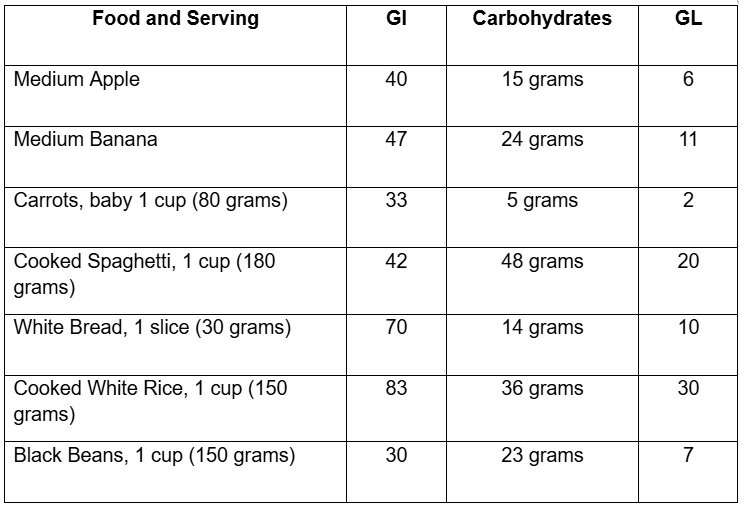
Glycemic load can be more useful than GI when considering actual portions because it accounts for how much carbohydrate you are eating.
A food can have a relatively high GI but a low glycemic load when a typical serving contains a small amount of carbohydrate.
However, glycemic load still does not tell you whether a food is nutritious overall, nor does it predict your exact blood glucose response.
What affects the glycemic index and glycemic load?
GI values are not necessarily fixed characteristics of an entire food category. Several factors can influence the response:
Ripeness: A ripe banana generally has a higher GI than an unripe banana.
Processing: More highly processed foods may be digested and absorbed more quickly. Grinding, milling, and breaking down a food's structure can make a difference.
Cooking method and time: The way a food is cooked can change how its starch is digested. For example, cooking pasta until it is very soft may produce a different response than cooking it al dente.
Food variety: Different varieties of rice, potatoes, grains, and fruits can have different GI values.
Fiber and food structure: The amount and type of fiber, along with how intact the food remains, can influence digestion and glucose absorption.
Other foods in the meal: Protein, fat, fiber, and acidic ingredients can affect gastric emptying and the overall blood glucose response.
Portion size also affects glycemic load because the amount of carbohydrate in the serving is part of the calculation. A larger serving generally means a higher glycemic load.
Does glycemic index or glycemic load matter?
They can be useful tools for understanding how carbohydrate-containing foods affect blood glucose, particularly in research and in some approaches to diabetes management. But they aren't necessary for everyone to track, and they shouldn't be used as a simple ranking system for determining whether foods are healthy.
A low-GI food is not automatically more nutritious than a high-GI food. For example, some foods with relatively low GI values may provide little fiber or few vitamins and minerals. Meanwhile, a food with a higher GI can still contribute valuable nutrients to an overall eating pattern.
Individual blood glucose responses also vary. Two people can eat the same food and respond differently. The GI value of a food does not tell you exactly what will happen to your blood glucose after eating it.
For most people, focusing on overall diet quality and variety, eating appropriate portions, and including a mix of foods that provide fiber, protein, and healthy fats is more practical than calculating the glycemic index or load of every meal.
The bottom line: Glycemic index and glycemic load describe the blood glucose effects of carbohydrate-containing foods. They can add some useful information, but they are not a measure of a food's overall healthfulness. You don't need to avoid foods simply because they have a higher GI, and you don't need to seek out low-GI foods at every meal. Your overall eating pattern matters much more than one number.
Resources and Further Reading:
Harvard Health, Choosing Good Carbs with the Glycemic Index
NIH National Library of Medicine, Glycemic index of foods: a physiological basis for carbohydrate exchange PMID: 6259925
University of Georgia, College of Agricultural & Environmental Sciences, Glycemic Index and Glycemic Load
University of Illinois Urbana-Champaign, Illinois Extension, Diabetes, Glycemic Load and Glycemic Index
University of Sydney, Glycemic Index: Everything you need to know about GI