
Are Fresh, Frozen, and Canned Fruits & Vegetables Really That Different?
If you have ever stood in the produce aisle wondering whether you really need to choose fresh versions of your favorite produce, or whether you could opt for frozen or canned fruits and vegetables, you're not alone.
It's a question I hear often.
Some people assume fresh is always the healthiest option. Not just assume, but state it outright.
Others wonder if frozen vegetables lose their nutrients or if canned fruit and vegetables are somehow less healthy because of “all the preservatives.”
Fresh, Frozen, and Canned Produce FAQ
Are frozen fruits and vegetables as healthy as fresh?
Yes. Frozen fruits and vegetables are typically picked at or near peak ripeness and frozen soon after harvest, helping preserve many of their nutrients. They can be just as nutritious as fresh produce.
Are canned vegetables nutritious?
Yes. Canned vegetables retain many vitamins, minerals, and fiber. If sodium is a concern, choose low-sodium or no-salt-added varieties when available, or rinse canned vegetables before eating to reduce sodium.
How long do fresh fruits and vegetables last?
It depends on the type of produce and how it's stored. Some fruits, like berries, are best eaten within a few days, while others, such as apples and carrots, may last for several weeks. Frozen produce generally keeps its best quality for 8 to 12 months, and most commercially canned fruits and vegetables remain at their best quality for 1 to 5 years when stored properly.
Should I rinse canned vegetables?
If they're packed with added salt, rinsing canned vegetables under running water can reduce some of the sodium. If you choose no-salt-added varieties, rinsing is optional and depends on your recipe and taste preferences.
Which is the healthiest option: fresh, frozen, or canned?
All three can be part of a healthy eating pattern. The best choice depends on your budget, schedule, preferences, and how likely you are to use them before they spoil. Eating more fruits and vegetables in any form is generally more important than focusing on which form is "best."
The healthiest fruits and vegetables are often the ones that fit your life and end up on your plate.
The good news is this:
Fresh, frozen, and canned fruits and vegetables can all be nutritious choices.
Each has advantages and limitations, and the best choice often depends on your budget, how quickly you'll use them, what you're preparing, and what is available.
Instead of asking which form is "best," a better question is:
Which one helps you eat more fruits and vegetables?
Fresh Produce
Fresh fruits and vegetables are what many people picture when they think about healthy eating.
When produce is fresh and in season, it often has the best flavor and texture.
During the summer, for example, peaches, blueberries, cherries, and raspberries are abundant in many areas. They can be delicious on their own or added to yogurt, oatmeal, salads, and smoothies. Or with the peaches, even grilled.
Fresh produce also offers the greatest variety.
You'll find foods like grapes, avocados, zucchini, leafy greens, herbs, and many specialty vegetables that may not be available in frozen or canned forms.
The downside?
Fresh produce doesn't last forever. Obviously.
Depending on the item, it may only stay fresh for a few days or a week before quality begins to decline, while others can last longer – carrots tend to come to mind. If I buy a two-pound bag, it can take a couple of weeks to finish, but they are still fine.
Now, that doesn't make fresh produce a poor choice. It simply means it requires a little planning.
Tips for Fresh Produce
Store fruits and vegetables properly.
For example:
Berries should be refrigerated and generally last about three to five days.
Cherries and grapes should also be refrigerated.
Peaches can ripen on the counter before being moved to the refrigerator.
Leafy greens stay freshest when refrigerated and kept dry.
Potatoes, onions, garlic, and winter squash should be stored in a cool, dry place rather than the refrigerator.
Buying only what you'll realistically use can also help reduce food waste.
Frozen Produce
Frozen fruits and vegetables are sometimes overlooked, but they're one of my favorite recommendations.
Why?
Because they're picked at or near peak ripeness and frozen soon afterward.
That means many nutrients are well preserved.
Frozen produce is also incredibly convenient.
Need a handful of blueberries for oatmeal?
A cup or two of broccoli for dinner?
A few slices of peaches for a smoothie?
You can use exactly what you need and return the rest to the freezer.
Frozen produce also lasts much longer than fresh.
Most frozen fruits and vegetables maintain their best quality for about 8 to 12 months when kept frozen continuously, although they remain safe beyond that if stored properly.
Not every fruit or vegetable is available frozen.
You'll commonly find blueberries, peaches, cherries, raspberries, strawberries, broccoli, green beans, spinach, peas, corn, and many others.
Some produce simply isn't widely sold frozen.
For example, you won't usually find frozen beets in most grocery stores, although fresh and canned beets are common.
Canned Produce
Canned fruits and vegetables often get an unfair reputation.
In reality, they can be an affordable, convenient way to include more produce in your meals.
Like frozen produce, fruits and vegetables intended for canning are generally processed soon after harvest.
That helps preserve many of their nutrients.
The biggest differences often involve ingredients that are added during processing.
For fruits, look for products packed in water or 100% fruit juice instead of heavy syrup when possible.
For vegetables, choose low-sodium or no-salt-added varieties if sodium is a concern. Rinsing canned vegetables can also reduce some of the sodium.
Canned foods have another advantage.
Shelf life.
Most commercially canned fruits and vegetables maintain their best quality for one to five years, depending on the product and storage conditions.
Because of this, they are excellent pantry staples for adding fruit and veggies to meals.
Why Aren't All Fruits and Vegetables Available in Every Form?
If you've ever looked for frozen beets or canned zucchini, you've probably noticed they can be difficult to find. (Maybe you have never thought of this, but in some of my classes we brainstorm the fruits and veggies we don’t tend to see among these options.)
That's because not every fruit or vegetable holds up well during every preservation method.
For example:
Beets are commonly sold fresh and canned, but frozen versions are much less common.
Zucchini is widely available fresh and frozen but is rarely sold canned because its texture changes significantly.
Grapes are usually sold fresh. Raisins are simply dried grapes, but canned or commercially frozen grapes are uncommon.
Bananas are typically purchased fresh, but they freeze well, and you can find frozen bananas at the store or freeze your own at home for smoothies and baking.
Avocados are available fresh and can also be purchased frozen in some stores. While canned avocado isn't common, refrigerated avocado purees and guacamole products are available.
Berries such as blueberries, raspberries, and peaches are excellent examples of produce that are commonly available both fresh and frozen.
The available forms often depend on how well the food maintains its quality after processing.
Are the Nutrients Different?
There are some differences, but they're not as dramatic as people tend to think.
Fresh produce may gradually lose some nutrients during storage, particularly if it sits in your refrigerator for several days before being eaten.
Frozen produce retains many nutrients because it's frozen quickly after harvest.
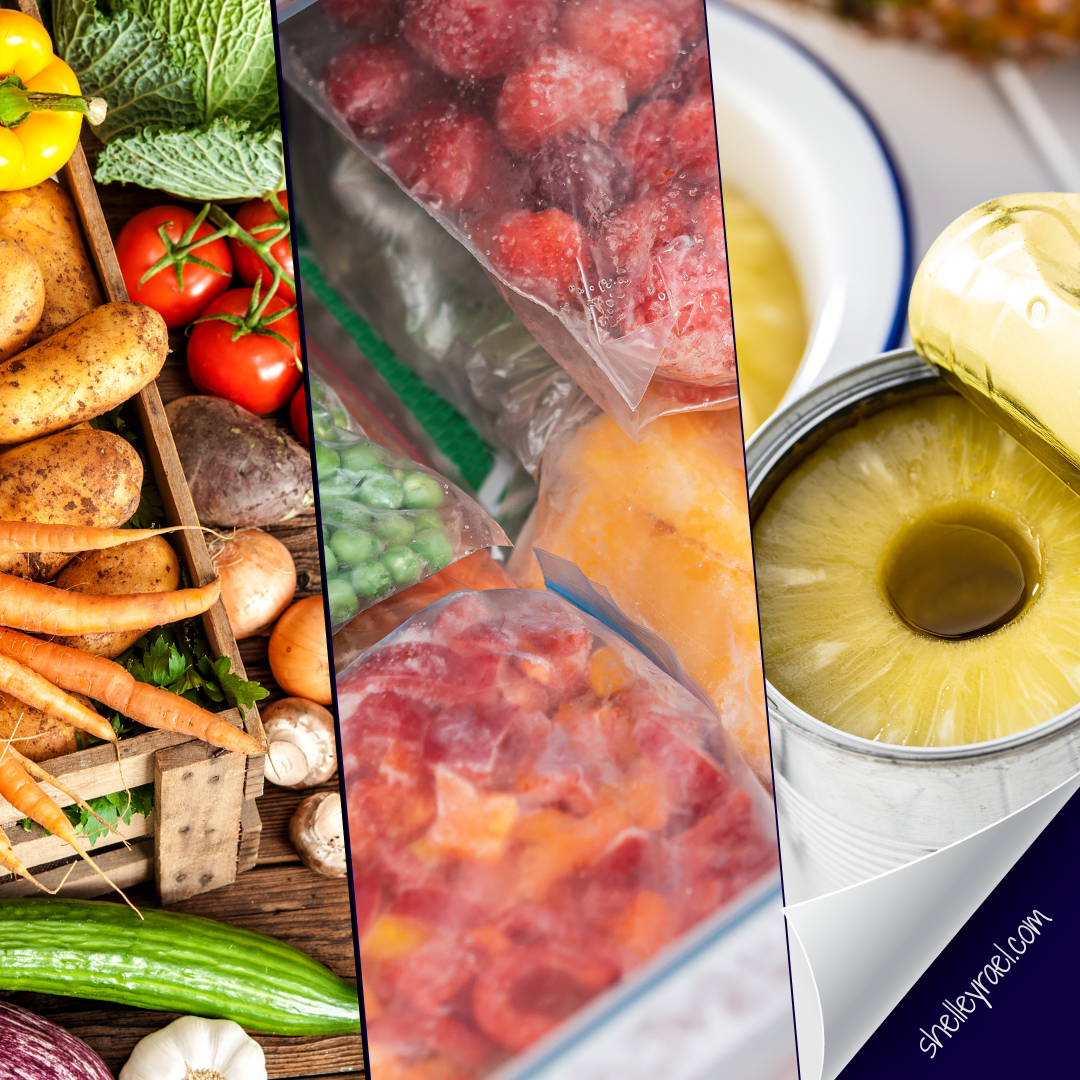
Canning can reduce some heat-sensitive vitamins, such as vitamin C, but many other nutrients, including fiber, minerals, and several vitamins, remain.
From a real-world standpoint, the nutritional differences among fresh, frozen, and canned produce are generally much smaller than the difference between eating fruits and vegetables regularly and not eating them at all.
Think About Your Lifestyle
The healthiest choice is often the one you'll use.
If fresh spinach frequently wilts before you can finish it, frozen spinach may be a better option.
If you like keeping peaches on hand for oatmeal during the winter, frozen peaches are an excellent choice.
If canned green beans help you put a vegetable on the dinner table during a busy week, that's a win.
Many people use all three forms depending on the situation.
Fresh berries in the summer.
Frozen berries for smoothies year-round.
Canned tomatoes for soups, sauces, and chili.
Fresh tomatoes for salads, tacos, or snacking.
Each has a place.
Key Takeaways
Fresh, frozen, and canned fruits and vegetables all contribute important nutrients to a healthy eating pattern.
Rather than focusing on which form is "best," consider what works for your schedule, budget, cooking habits, and personal preferences.
Fresh produce has flavor and variety.
Frozen produce offers convenience, extended shelf life, and excellent nutrient retention.
Canned produce offers affordability, shelf stability, and quick meal preparation.
The goal isn't to choose one over the others.
The goal is to eat more fruits and vegetables in whatever form helps you do that consistently.
So, enjoy fresh peaches in the summer, frozen blueberries in a smoothie, canned tomatoes in a soup, and frozen broccoli with dinner. They are all options that support your health.
And that's what matters most. Because… the best fruits and vegetables are the ones you actually eat.
Read More:
Additional Resources:
A 5-step plan to eat more produce, Harvard Health Publishing