
More Fruits and Vegetables: What Counts and How Much Do You Really Need?
More Fruits and Vegetables: What Counts and How Much Do You Really Need?
"Eat more fruits and vegetables."
It's probably one of the most repeated pieces of nutrition advice around.
I know I have said it to nearly every patient, client, and student I've encountered in my professional work. It’s even a joke in some of my classes. I tell them that whenever I ask a question, the answer is always, “more fruits and vegetables.”
How do we solve world peace? More fruits and vegetables!
Of course it isn’t that simple, but the mantra “eat more fruits and vegetables” is not wrong.
But what exactly counts as a fruit or vegetable? Does frozen count? What about canned? Dried? Juice? Potatoes? Beans? I get these questions all the time.
And what about the argument that carrots, fruit, and other produce are "full of sugar"? Yes, people do say this – more than you can probably imagine.
But here I want to take a different, more open approach, because you don't need another lecture about eating your vegetables.
Frequently Asked Questions
Do canned fruits and vegetables count?
Yes. Canned fruits and vegetables count. When practical, choose options with little or no added sugar or sodium, or drain and rinse canned foods.
Do frozen fruits and vegetables count?
Yes. Frozen fruits and vegetables absolutely count. They can also be a convenient, affordable way to keep produce available.
Do potatoes count as a vegetable?
Yes. Potatoes are vegetables, specifically starchy vegetables.
Are potatoes healthy?
Yes. Potatoes can be part of a nutritious eating pattern. What we add to or do to potatoes can change the overall nutritional profile, so the potato itself isn't necessarily the problem.
Are beans vegetables?
Yes. Beans, peas, and lentils are included in the vegetable group and can also contribute protein and other nutrients.
Does fruit juice count as fruit?
Yes, 100% fruit juice counts as fruit. However, whole fruit is generally a better everyday choice because it provides fiber and is more filling. Keep juice to a modest portion.
How much fruit and vegetables should I eat each day?
It varies based on individual calorie and nutritional needs. As a general guide, a 2,000-calorie eating pattern includes about three servings of vegetables and two servings of fruit per day.
Are fruits and vegetables too high in sugar?
No. Fruits and vegetables contain naturally occurring sugars, but that doesn't make them equivalent to foods high in added sugars. The overall food, including its fiber and other nutrients, matters.
Does dried fruit count as fruit?
Yes. Dried fruit counts as fruit, but it is more concentrated than whole fruit, so portions are smaller.
Are frozen vegetables as healthy as fresh vegetables?
Yes. Frozen vegetables can be just as nutritious as fresh vegetables. Nutrient content varies by food and processing, but frozen vegetables are a practical way to include more vegetables in your diet.
What you may need is to know what actually counts, what matters, and how to add more of these foods to your diet without completely changing how you eat.
First, what counts as a fruit or vegetable?
From a nutrition standpoint, I'm not particularly interested in arguing about whether a tomato, avocado, or even a chile is technically a fruit or whether something else qualifies botanically.
Eat it.
Fresh, frozen, canned, and dried fruits and vegetables all count.
Yes, there are differences. Some canned vegetables contain added sodium. Some canned fruits contain added sugar or are packed in syrup. So check the label when it makes sense.
But if your choice is between canned green beans and no vegetables because you didn't buy fresh green beans this week, I'm voting for the green beans. Stop making excuses here.
You can drain canned vegetables, and rinsing can reduce some of the sodium (or choose no-added-salt versions)
You can choose fruit packed in water or juice rather than syrup when that's an option.
But you don't need to make purchasing produce a nutrition research project. Or an excuse to NOT eat something.
Frozen broccoli is still broccoli.
Canned peaches are still fruit.
Raisins are still fruit.
And the bag of frozen berries in the freezer absolutely counts. And could have more nutrients than their fresh counterparts. And you can still get them even when fresh blueberries are out of season.
The Dietary Guidelines for Americans specifically include fresh, frozen, dried, and canned fruits and vegetables as options, emphasizing versions with little or no added sugar when possible.
What about fruit juice?
Yes, 100% fruit juice counts as fruit.
But I would not make juice your primary way of getting fruit. In fact, I would really suggest limiting it, but you don’t need to eliminate it.
Why?
Whole fruit gives you the fruit's fiber and requires you to chew it, which makes it more filling and takes more time to eat. Juice makes it easy to drink the equivalent of several pieces of fruit in a relatively short time.
So, if you enjoy orange juice with breakfast, I'm not going to tell you that it doesn't count. It does count if it is 100% fruit juice without added sugars.
I would simply keep juice to a modest portion, rather than drinking large glasses throughout the day. And, while this might seem obvious to some, I have had clients who consume a lot because “it’s juice and an easy way to get fruit.” And when I say a lot, I mean 64 fluid ounces a day.
The Dietary Guidelines recommend consuming 100% fruit or vegetable juice in limited portions.
My recommendation? One serving (4-8 fluid ounces) of juice a day is plenty for most people. And when you can, have the whole fruit.
Yes, potatoes count
This one makes me laugh a little because potatoes somehow became a nutrition demon with no benefits. But that's far from the truth.
Potatoes are vegetables. That’s a fact.
White potatoes are classified as starchy vegetables, along with foods like corn, plantains, cassava, and other starchy roots and tubers. USDA guidance includes white potatoes in the vegetable group.
So why do potatoes sometimes get treated like they don't count? Or that they are the worst?
I think part of the problem is what we tend to do with them.
A baked potato topped with a reasonable amount of toppings is one thing.
A large serving of French fries is another.
Tater tots, chips, loaded baked potatoes, and other potato-based foods can have much more sodium, saturated fat, and added ingredients than the potato itself.
So sometimes the question isn't "Are potatoes healthy?"
It's "What did we do to the potato?"
This is why I say potatoes aren’t the “problem”; it’s what we do to them. And it is okay to have fries or chips or a loaded baked potato. Just don’t blame the potato for being a “sometimes food” in those versions.
What does "starchy vegetable" actually mean?
"Starchy" doesn't mean bad.
It generally refers to vegetables that contain more carbohydrates and starch (a carbohydrate) than vegetables such as leafy greens, broccoli, cucumbers, or peppers.
Potatoes, corn, peas, winter squash, and other foods can fall into this category.
Starchy vegetables can totally be part of a nutritious eating pattern.
I tell people they don’t need to eliminate starchy vegetables or fill their entire plate with only non-starchy vegetables.
It's variety.
Maybe dinner includes roasted broccoli and potatoes.
Maybe a taco bowl has peppers, onions, corn, and beans.
Maybe lunch is a baked sweet potato with black beans and salsa.
You don't have to choose between "healthy vegetables" and "carbs."
And yes, beans count, too
Beans, peas, and lentils are an interesting category of food because they can count as both vegetables and protein, depending on the food pattern you're using.
They provide protein, fiber, vitamins, minerals, and carbohydrates, and they're an easy way to add more plant foods to meals.
Black beans in tacos?
Count them.
Chickpeas in a salad?
Count them.
Lentils in soup?
Count them.
No need to make this complicated.
"But aren't fruits and carrots full of sugar?"
This is one of my favorite nutrition arguments because the comparison is so ridiculous when you put it into real food quantities.
Yes, fruits and vegetables contain naturally occurring sugars.
So do many other foods.
But the amount and the overall food matter.
Consider carrots.
A pound of raw carrots contains roughly 20 to 22 grams of naturally occurring sugar, depending on the specific carrots. A standard 1.74-ounce package of Peanut M&M's contains about 24 grams of sugar, most of it added sugar.
We’re talking about roughly a pound of carrots versus one little package of Peanut M&M's to get a similar amount of sugar.
Carrots also give you fiber, beta-carotene, potassium, and other nutrients.
This doesn't mean Peanut M&M's are forbidden. Never!
It means that saying "carrots have sugar, so they're basically candy" is an absurd way to think about nutrition and, even more specifically, vegetables.
Sugar content doesn't tell you everything about a food.
Variety matters more than finding the "best" fruit or vegetable
Instead of trying to find the healthiest vegetable, think about variety.
Include different colors.
Include leafy greens, red and orange vegetables, cruciferous vegetables, starchy vegetables, beans, and other vegetables.
Eat different fruits, too.
And don't worry if your produce choices aren't evenly distributed every single day.
You might eat berries one day and apples the next.
You might have broccoli three times this week and frozen peas twice.
You might have peaches over and over in the summer, but not have them much the rest of the year.
That's fine.
Federal guidance emphasizes variety and colorful vegetables and fruits, rather than one specific produce choice.
What does a serving actually look like?
This isn’t as straightforward and can get confusing because serving sizes vary by food.
Generally, a cup is often a useful starting point for fruits and vegetables, but it isn't universal.
For example, one cup of raw or cooked vegetables generally counts as a cup from the vegetable group. Leafy greens are different because two cups of raw leafy greens count as one cup of vegetables.
For fruit, one cup of whole fruit generally counts as one cup, while dried fruit is more concentrated, so one-half cup of dried fruit counts as one cup from the fruit group. One cup of 100% fruit juice also counts as one cup from the fruit group. And then how do we measure grapes or strawberries? We often measure grapes or strawberries by the number, but that can still vary.
But here's the important part:
You don't have to measure every carrot, strawberry, or green bean you eat.
These are useful guidelines, not a requirement to carry measuring cups around all day.
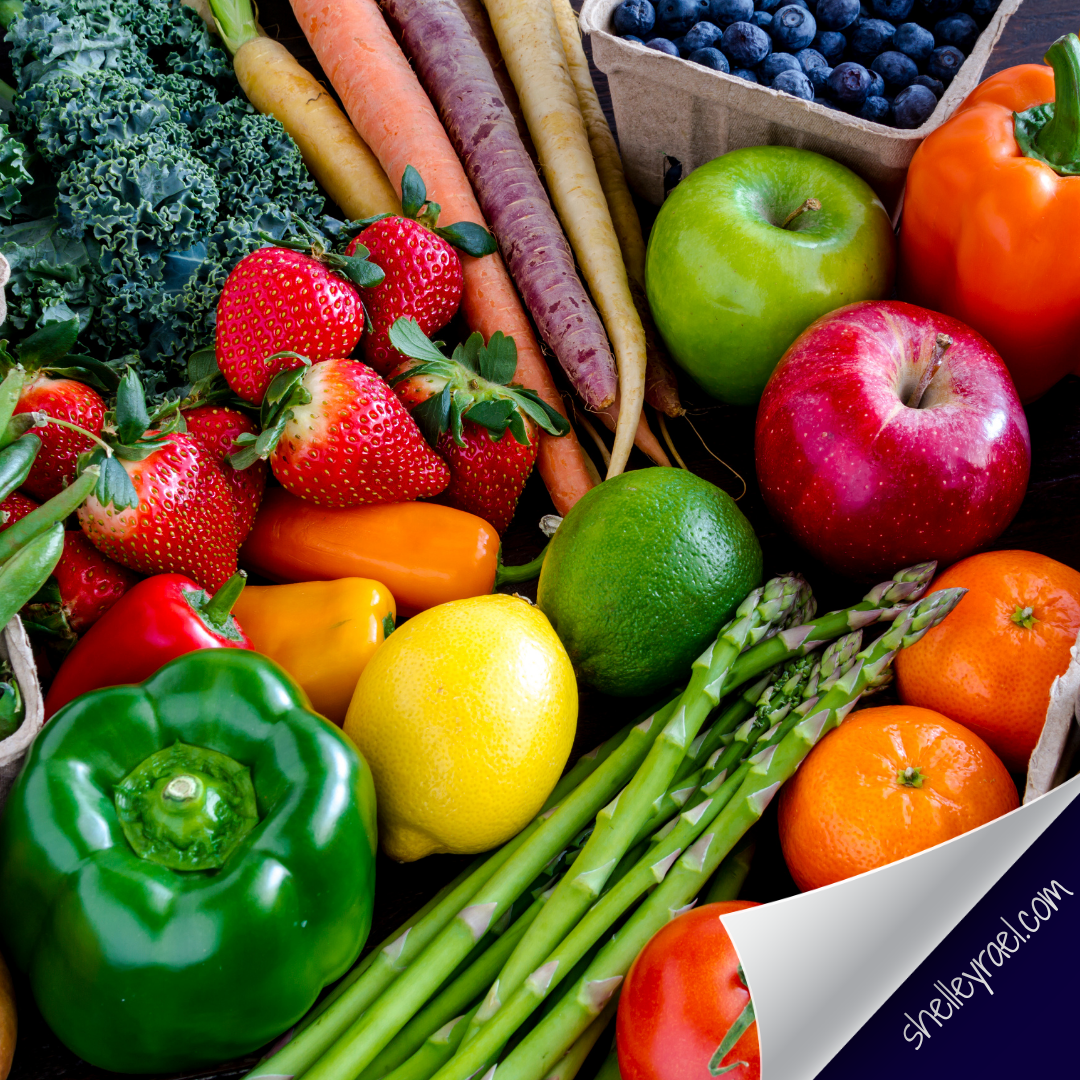
For a 2,000-calorie dietary pattern, the Dietary Guidelines use a general goal of about three servings of vegetables and two servings of fruit per day, with individual needs varying based on calorie requirements.
What if produce is expensive?
This is where "just buy fresh produce" advice falls apart and can feel rigid.
Fresh berries in January can be expensive.
A bag of frozen berries may be much more accessible.
Canned tomatoes, canned beans, frozen vegetables, bananas, apples, carrots, cabbage, and other produce can be budget-friendly options. And reduce food waste
USDA also recommends combining fresh, frozen, and shelf-stable foods when planning meals and shopping on a budget.
You don't get extra nutrition points for buying the most expensive version. And don’t even get me started on this “only buy organic” concept. Buy what you can afford and will eat.
Convenience counts, too
If you are more likely to eat baby carrots because you don't have to peel or chop them, buy the baby carrots.
If frozen vegetables mean you have vegetables with dinner, keep frozen vegetables in the freezer.
If pre-cut fruit means you eat fruit instead of letting the whole pineapple sit on the counter until it starts to ferment, buy the pre-cut fruit.
If canned beans make dinner possible on a Wednesday night, use canned beans.
Convenience is not something to feel shamed for.
It is part of real life.
How to get more without changing your entire diet
You don't need to redesign your diet around fruits and vegetables.
Instead, look at what you're already eating and add something.
Put berries on your oatmeal.
Add spinach to eggs.
Put lettuce and tomato on a sandwich.
Add frozen vegetables to pasta.
Have an apple with lunch.
Add salsa to your eggs, tacos, or baked potato.
Keep baby carrots or sliced peppers available for snacks.
Add beans to soup, chili, tacos, salads, or grain bowls.
Use frozen fruit in a smoothie.
Add a vegetable to the dinner you're already planning.
That's the point.
More fruits and vegetables doesn't have to mean completely changing what you eat.
It can simply mean adding more of what is already available.
Key Take Aways
You don't need to obsess over whether a food is technically a fruit or vegetable.
You don't need to avoid potatoes because they're starchy.
You don't need to avoid carrots because they contain sugar.
You don't need to buy everything fresh.
You don't need to cook every vegetable from scratch.
And you don't need to hit some imaginary produce quota every single day to "do nutrition right."
Aim for variety.
Include fruits and vegetables in forms that fit your budget, schedule, preferences, and cooking skills.
Fresh, frozen, canned, and dried all have a place.
Whole fruit should generally be your main source of fruit, with juice kept to a modest amount.
Include both starchy and non-starchy vegetables.
And most importantly, make it easier to eat more of these foods rather than creating another set of rules about how you are supposed to eat.
Because when it comes to fruits and vegetables, the best choice is often the one you will actually eat.